Visual communication aid: Chromosome inversions
This communication aid has been produced to complement discussions about chromosome inversions during consultations with patients.
View and download communication aid(s)
There is one communication aid available to view and download (.pdf):
Double-sided printing in colour is recommended (but not required). All content is also included below in an accessible format.
More information about these and other VCAs is available in this article.
Chromosomes explained
We all have over 20,000 genes, which provide instructions for how our body works. Our genes are packaged into structures called chromosomes.
People usually have 23 pairs of chromosomes: 22 pairs of autosomes and one pair of sex chromosomes (XX or XY). One chromosome from each of each pair is inherited from each parent. Our sex chromosomes are called X or Y, and usually determine sex assigned at birth.
Chromosomes have a short arm, known as the p arm, and a long arm, known as the q arm. The p arm and q arm are joined together by a centromere.
You can learn more about the basics of our genome in this VCA: Genes, chromosomes and DNA.
What is a chromosome inversion?
A chromosome inversion is when a segment of a chromosome breaks off, turns 180 degrees and reattaches in the same place on the same chromosome. An insertion can be large or small and may include part of a gene, a whole gene or multiple genes.
There are two types of chromosome inversion:
- Paracentric inversion: an inversion that does not include the centromere.
- Pericentric inversion: an inversion that includes the centromere.
Chromosome inversions are usually described based on the chromosome affected and the location of the inversion on the chromosome.
Some inversions may not have any effect on a person’s health. Others may cause a genetic condition or cause problems when passing genes from parent to child.
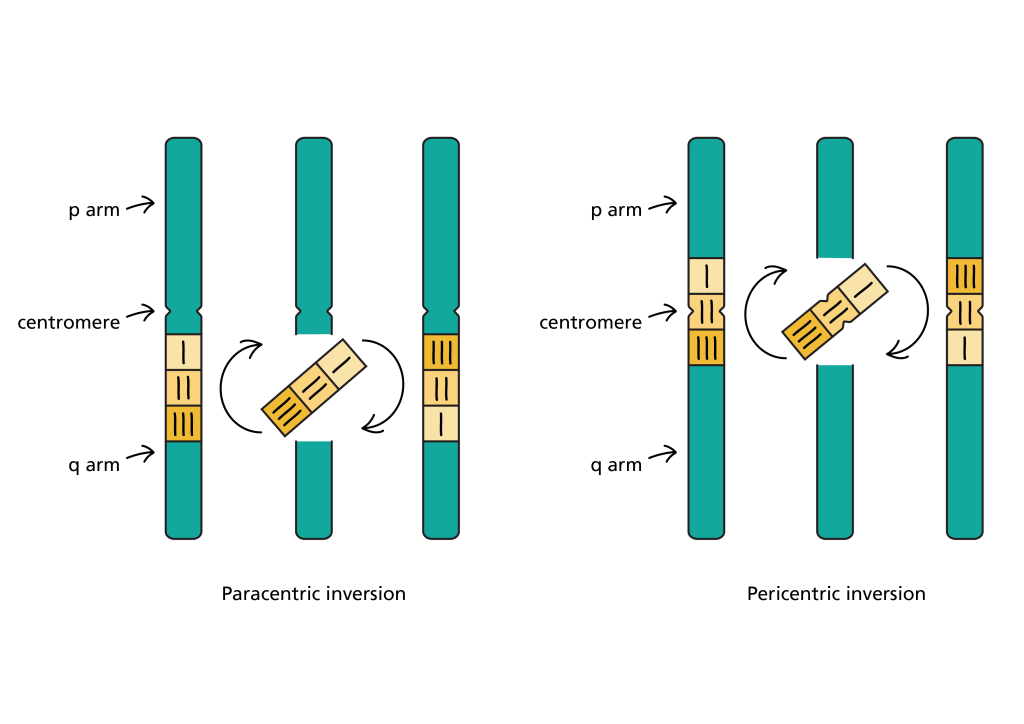
Figure 1: Examples of a paracentric chromosome inversion and a pericentric chromosome inversion
(View larger size)
Key terms
- Genome: The complete set of genetic information found inside a cell.
- Chromosome: Packages of DNA that are found in our cells.
- Autosome: A chromosome that is not a sex chromosome
(named 1–22). - Sex chromosome: A chromosome containing genes that determine the sex a person is born as (named X or Y).
- p arm: The short arm of a chromosome.
- q arm: The long arm of a chromosome.
- Centromere: The part of a chromosome that joins the p arm and the q arm.